The Part You're Hiding Is the Part They're Waiting For
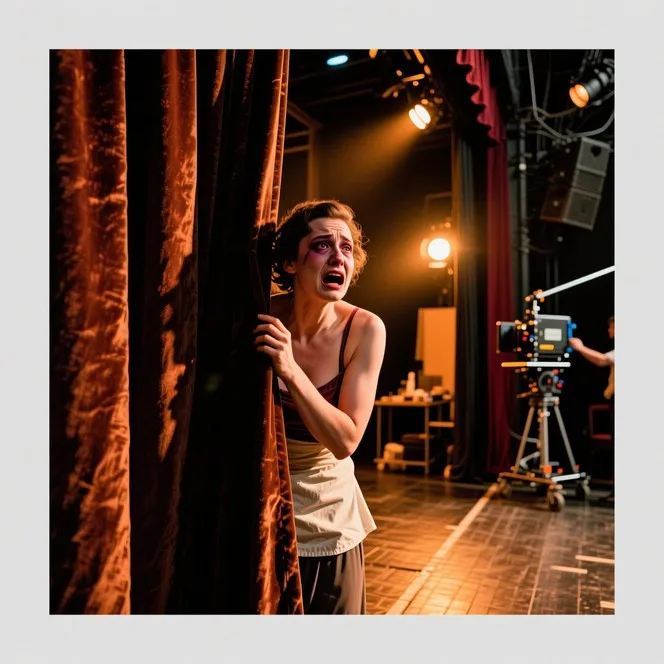
Photo: performer backstage vulnerable authentic moment dramatic lighting, via images.stockcake.com
Let me paint you a picture.
You've spent months—maybe years—building your brand. You've got a consistent color palette, a content calendar, a carefully worded bio that hits all the right notes without revealing too much. You post on schedule. You engage with comments. You do everything the marketing playbooks tell you to do.
And yet. Something isn't connecting. The numbers are fine, maybe even decent, but the relationship isn't there. Nobody's obsessed. Nobody's sending your work to their best friend at 2 a.m. with a message that just says "this is us."
Here's what's actually happening: you've optimized yourself out of yourself. And audiences—real ones, the kind that stick around and actually care—can smell that from a mile away.
The Paradox at the Center of Personal Branding
We live in an era where "authenticity" has become its own marketing category, which is its own special kind of hell. Every brand consultant will tell you to "be authentic." Every social media guru has a course on "showing your real self." And then they hand you a content framework that tells you exactly how to structure your authentic moments for maximum engagement.
The result is a kind of performed authenticity—vulnerability as content strategy, rawness as aesthetic. And people feel it. They can't always articulate it, but there's a hollow quality to curated realness that registers somewhere in the gut.
Real authenticity—the kind that actually builds a following worth having—isn't strategic. It's terrifying. It's the thing you almost didn't post. The story you've been sitting on because you're not sure how it'll land. The part of your creative identity that doesn't fit neatly into your brand's existing narrative.
That's the thing. That's always been the thing.
Case Study in Weird: How Lil Nas X Rewrote the Rules
When Lil Nas X first broke through with "Old Town Road," the easy play would have been to soften his edges, stay in the lane that the hit created, and keep delivering variations on the same product. The industry certainly would have preferred that.
Instead, he leaned harder into everything that made people uncomfortable—his queerness, his sense of humor, his willingness to be genuinely provocative rather than provocative-adjacent. The Satan shoes. The pole-dancing-down-to-hell music video. The public conversations about mental health and sexuality that went way beyond what a pop star "needs" to share.
Every one of those moves was a risk. Every one of them deepened his connection with an audience that felt genuinely seen by him, because he was showing them something real—something that had actual stakes attached to it. You don't manufacture that kind of loyalty. You earn it by being willing to lose people.
The Audience Isn't Looking for a Product
Here's the thing that gets lost in the branding conversation: people don't follow creators because they've found the perfect product. They follow creators because they've found a mirror. Something that reflects back a part of themselves they don't usually get to see acknowledged—especially the parts that feel too strange, too dark, too specific, or too vulnerable to bring up in polite company.
Think about why certain artists develop cult followings while technically superior artists with bigger budgets stay mid-tier. It's almost never about the quality of the output. It's about the quality of the recognition. The sense that this person gets something about the human experience that most people don't talk about.
Amanda Palmer built one of the most devoted fanbases in independent music not by being the most technically accomplished musician in the room, but by being radically, sometimes painfully open about her creative struggles, her financial precariousness, her complicated feelings about art and commerce and connection. Her Kickstarter campaign—which raised over a million dollars from fans—wasn't funded by people buying a product. It was funded by people who felt like they knew her, because she'd let them.
What You're Actually Afraid Of
Let's get specific, because "be vulnerable" is useless advice without understanding what vulnerability actually costs.
Most creators aren't hiding things because they're calculating. They're hiding things because those things feel like liabilities. The depression that derailed three years of your career. The creative obsession that's a little too niche to be commercially viable. The aesthetic sensibility that doesn't fit the genre you're supposed to be in. The personal history that's messy and doesn't resolve into a clean redemption arc.
Those aren't liabilities. Those are the differentiators.
In a content landscape where everyone has access to the same tools, the same platforms, and roughly the same playbooks, the only thing that's genuinely scarce is a specific human perspective that couldn't have come from anyone else. Your weird is the scarcest thing you own. And you're out here treating it like a liability.
The Uncomfortable Differentiator
Billie Eilish's early career is a masterclass in this. She didn't break through because she was the best singer or the most polished performer. She broke through because she was willing to talk about the stuff that teenage girls—and a lot of adults—were experiencing but not seeing reflected back at them: body dysmorphia, depression, the specific alienation of being hyper-online and emotionally isolated simultaneously. Her aesthetic was strange. Her music was strange. And it connected with millions of people precisely because it didn't feel designed to connect with millions of people.
The irony is that trying less hard to be universally appealing is often what creates universal appeal.
How to Actually Do This
I'm not going to give you a five-step framework, because this isn't that kind of piece. But I will tell you what the actual practice looks like.
It looks like sitting with the thing you almost didn't include and asking why. It looks like noticing when you've softened something for an imagined audience and deciding whether that was a craft choice or a fear choice. It looks like identifying the parts of your creative identity that you've been keeping in a separate, unlisted folder and asking what would happen if you moved them to the front.
It's not about dumping everything on the internet with no filter. Vulnerability without craft is just noise. It's about trusting that the things that make you feel most exposed are often the things that make your work most necessary.
The audience that's right for you isn't waiting for the polished version. They're waiting for the one you're scared to show them.
Stop making them wait.